
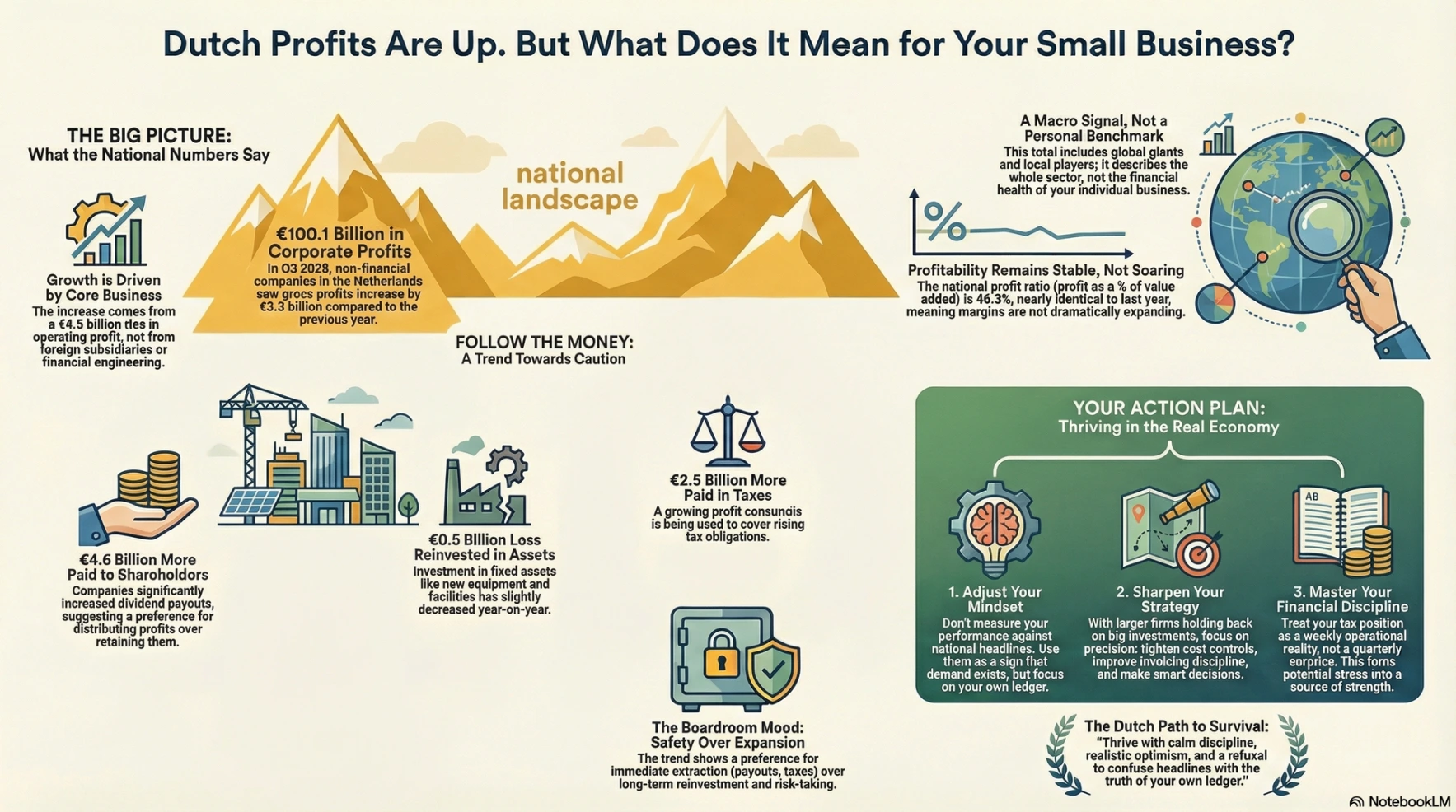
In the third quarter of 2025, non-financial companies in the Netherlands reported a consolidated gross profit before tax of €100.1 billion. That is €3.3 billion more than in the same quarter last year. Statistics Netherlands (CBS) says the rise is mainly driven by higher operating profit, which reached €80.1 billion, up €4.8 billion year-on-year. At first glance, this sounds like the country is doing well. It sounds like the engine is running smoothly again.
But the moment you translate this headline into daily business life, the picture becomes more nuanced. “Non-financial companies” includes everything that is not a bank or insurer: manufacturers, wholesalers, retailers, logistics firms, large service businesses. It includes giants with global subsidiaries and also smaller local players. When CBS speaks about €100.1 billion, it is describing the total weight of an entire sector, not the breathing room of your own business. And that distinction matters, because national profit can rise while many small business owners still feel trapped between rising costs, cautious customers, and a tax environment that does not forgive mistakes.
To understand what is happening, it helps to look at what sits underneath the big number. CBS breaks gross profit before tax into four pieces: operating profit, non-product-related subsidies, profits from foreign subsidiaries, and “other profit.” In Q3 2025, the operating profit part was the clear driver. But the contribution from foreign subsidiaries was €1.2 billion lower than a year earlier, and “other profit” was also down. This tells us something simple: the profit growth is not coming from exotic financial engineering or overseas windfalls. It is coming from the core business machine. Companies, overall, sold and operated in a way that produced more operating surplus.
Now, here is where the small entrepreneur should pay attention: CBS also reports that companies paid €2.5 billion more in taxes than in the same quarter last year. And they distributed €4.6 billion more in dividends. Meanwhile, investments in fixed assets were €0.5 billion lower. This sequence is telling. More profit is being taxed, more is being sent to shareholders, and slightly less is being reinvested. In other words, a growing part of corporate profit is being converted into immediate extraction instead of long-term capacity. That does not automatically mean something “bad,” but it does reveal the mood in boardrooms: many firms prefer certainty and payouts over risk and expansion.
Let me anchor this in a small, familiar scene. Imagine a local printing company in Utrecht with twelve employees. The owner had a strong quarter because several clients restarted campaigns that were paused last year. Revenue improved, but paper and energy costs did not drop as much as hoped. When the owner finally sees a healthier margin, the reflex is not “let’s invest in a new machine.” The reflex is “let’s restore cash, reduce exposure, pay the tax bill, and maybe reward ourselves after two years of restraint.” That is not greed. That is self-preservation. And it mirrors what the national data suggests: profit is rising, but confidence is still selective.
CBS also notes that the profit ratio of non-financial corporations, operating profit as a percentage of added value, was 46.3%, almost identical to 46.2% in Q3 2024. That is an important detail, because it signals that profitability is not exploding. It is stable. Both operating profit and added value grew at nearly the same rate. So the story is not “companies are suddenly taking much more margin.” The story is “business activity is producing more value and the profit follows.” That is healthier than an inflation-driven margin spike, but it also means the gains might not feel dramatic for smaller firms dealing with day-to-day volatility.
So what should a micro or small business owner do with this information? The first adjustment is mental: do not read this headline as a verdict on your performance. National corporate profit rising is a macro signal, not a personal benchmark. It tells you the economy has not collapsed, and that demand exists somewhere. But it does not guarantee that your sector, your region, and your customer base will follow the same curve.
The second adjustment is strategic: if the national trend is “more profit, more tax, more dividend, less investment,” then cash discipline becomes even more valuable for the small business owner, not less. In a market where larger firms are holding back investment, competition may temporarily soften. That can create an opening for small firms that invest in precision rather than expansion: better invoicing discipline, tighter cost control, smarter supplier terms, and faster decisions on unprofitable work. You do not need a big investment budget for that. You need clarity and the willingness to measure what you normally guess.
And finally, there is a quieter takeaway that many entrepreneurs overlook: if taxes on profits are rising at the macro level, it is a reminder that the state will always arrive on time, even when your clients do not. You cannot negotiate with the tax calendar using optimism. The most practical habit you can build is to treat your tax position as a weekly operational reality, not a quarterly surprise. In calmer times this feels boring. In uncertain times it becomes the difference between strength and stress.
The Dutch economy is showing signs of resilience, and the corporate sector is producing more profit than a year ago. That is good news in the broad sense. But the deeper message for the small business owner is not celebration. It is orientation. The national numbers suggest that companies are choosing safety and distribution over big reinvestment. In that kind of climate, the businesses that thrive are rarely the loudest or the most ambitious. They are the ones that quietly tighten their steering, keep their cash honest, and make small decisions with big consistency.
That is not dramatic. It is not heroic. But it is how long businesses survive in the Netherlands: with calm discipline, realistic optimism, and a refusal to confuse headlines with the truth of your own ledger.
Paolo Maria Pavan
Head of GRC | Market Analyst
Paolo Maria Pavan is a Governance, Risk & Compliance strategist and market analyst known for turning complexity into operational clarity. He works with freelancers, founders, and established SMEs, helping them translate governance discipline, market intelligence, and economic signals into structured execution and defensible growth.