
This year marks a quiet turning point. For the first time in our country’s history, there are more people aged 65 and over than people under 20. It did not arrive with a headline-grabbing crisis or a sudden shock. It arrived like most structural changes do: silently, steadily, and already embedded in daily business life. For many micro and small entrepreneurs, this shift is not a future scenario. It is already shaping who walks into the shop, who applies for a job, who calls in sick, and who asks for flexibility.
Statistics Netherlands projects that this trend will deepen over the coming decades. By 2070, the Netherlands is expected to have around 2.5 million more inhabitants than today, mainly due to migration, not births. At the same time, the number of people aged 65 and over will grow far faster than the number of young people. Those over 80 will more than double. Behind these figures is a simple reality: we are becoming an older society, with fewer people of working age relative to the total population.
For a large corporation, this becomes a strategy paper. For a small business, it becomes a Tuesday afternoon problem. I recently spoke with the owner of a small logistics company. Nothing dramatic, no crisis. Just a pattern. Two experienced drivers approaching retirement within five years. Fewer young applicants than before. More conversations about part-time work, physical strain, and long-term sustainability. He was not worried about 2070. He was worried about next winter.
The numbers help explain why this feels familiar. People aged 20 to 65 currently make up just under 59 percent of the population. That share is expected to drop to around 55 percent by 2040. In absolute terms, the working-age population remains relatively stable for now, but the pressure increases because more people depend on that group for care, services, and economic support. At the same time, births have been lower than deaths in recent years, and although births are expected to rise again later, the balance remains fragile.
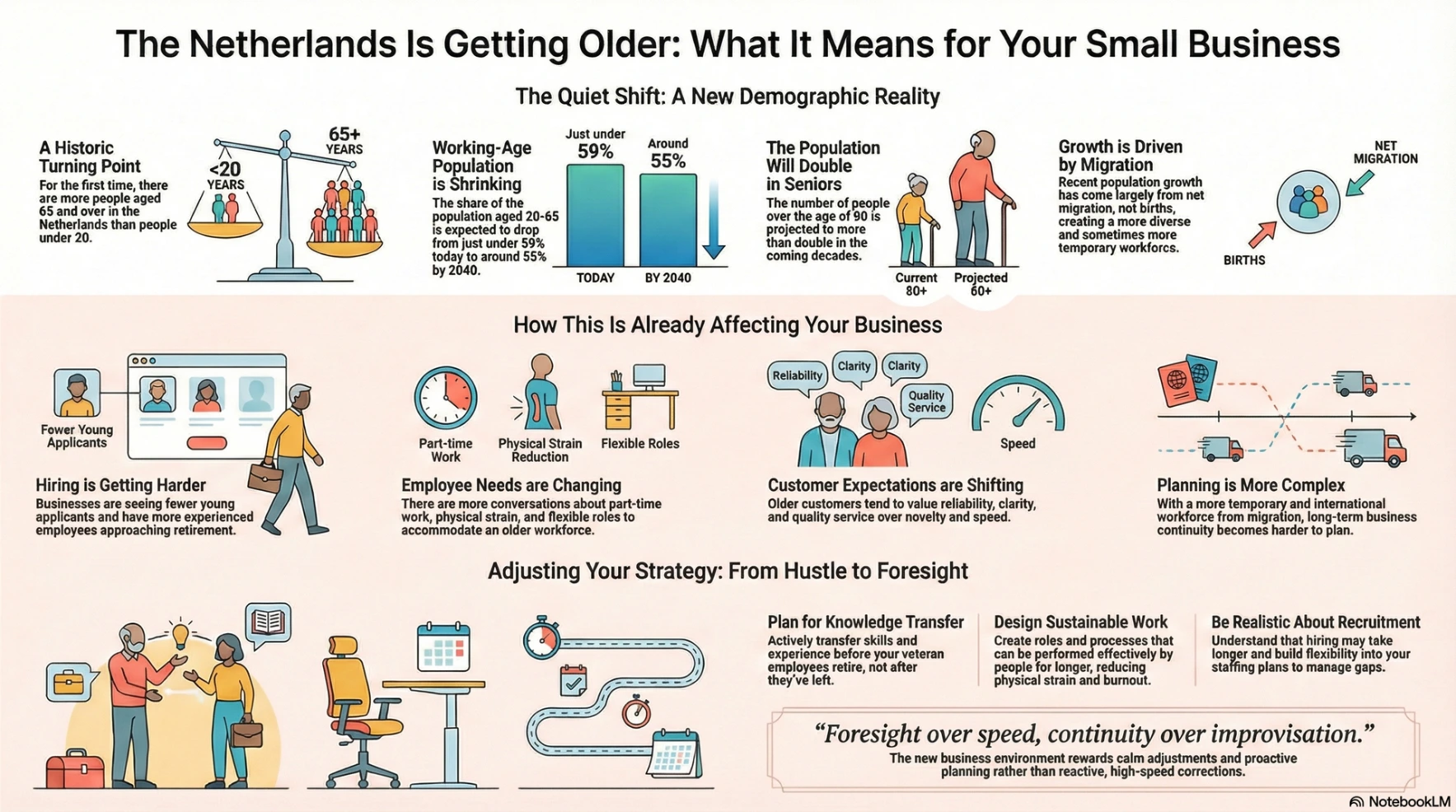
Migration fills part of the gap, and it will continue to do so. In recent years, population growth came largely from net migration. That flow is expected to slow somewhat, not stop. For entrepreneurs, this means a workforce that becomes more diverse, more international, and often more temporary. People arrive, work, learn, and sometimes leave again. This is not a political statement. It is an operational one. Planning becomes harder when continuity depends on variables outside your control.
None of this means decline. It means adjustment. Older customers behave differently. They value reliability, clarity, and service over novelty. Older employees bring experience, stability, and judgment, but may need different rhythms or roles. Younger workers are fewer, but often more selective, and less willing to trade all their time for marginal security. These are not problems to solve once. They are conditions to work with.
For micro-entrepreneurs, the practical response is rarely dramatic. It starts with noticing patterns early rather than reacting late. It means thinking about knowledge transfer before someone retires, not after. It means designing work that can be done sustainably for longer, rather than assuming constant renewal. It means being realistic about recruitment timelines and building slack where possible, even when margins are thin.
The population will keep growing, but more slowly. Deaths and births will roughly balance for years. Migration will fluctuate. Forecasts carry uncertainty, as they always do. What does not change is the direction of travel. An older society is not a weaker one, but it is a different one. It rewards foresight over speed, continuity over improvisation, and calm adjustments over late corrections.
For small business owners, clarity is an asset. You do not need to redesign your company for 2070. You need to understand why hiring feels harder, why customer expectations shift, and why resilience increasingly comes from structure, not hustle. Demography does not shout. It whispers. Those who listen early tend to make quieter, better decisions.
Paolo Maria Pavan
Co-Founder Xtroverso
Strategic analyst of the Dutch market, Paolo Maria Pavan delivers exclusive insights for Xtroverso clients.
In 2025 he stepped away to focus on other projects, yet remains available on demand for key assignments.
This section decodes economy, social signals, and entrepreneurship through data and patterns the press will not tell you, helping you lead with clarity and direction.